
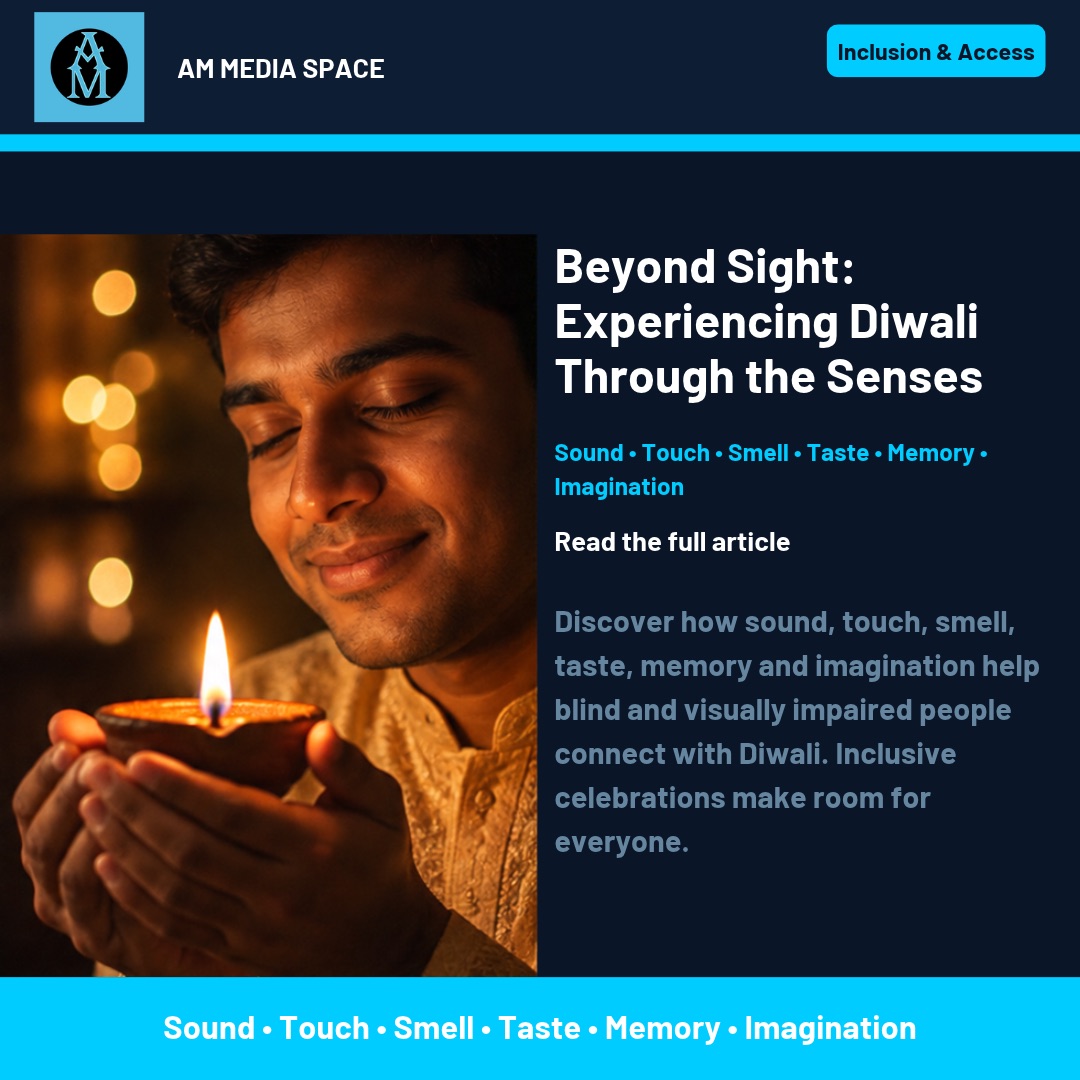
Diwali, often known as the Festival of Lights, is a celebration associated with light, hope, new beginnings and the triumph of good over evil. Across the world, families and communities mark the occasion by lighting traditional lamps, decorating their homes, creating colourful rangoli patterns, sharing food, exchanging gifts and enjoying music and fireworks.
But what does the Festival of Lights mean to someone who is blind or has limited vision? If much of the celebration is traditionally associated with bright colours, glowing lamps and spectacular displays, how can someone experience the atmosphere and meaning of Diwali without relying on sight?
The answer is that Diwali can be experienced through far more than what the eyes can see. Sound, touch, smell, taste, memory, imagination and shared experiences can all play an important part. The experience will be different for every individual, depending on their vision, preferences, sensory experiences and relationship with the festival.
Experiencing Diwali through sound
Hearing can be particularly important when experiencing a celebration without sight. The sounds of family conversations, traditional music, singing, bells, prayers and the excitement of a community gathering can help create a sense of atmosphere and connection.
Fireworks can also be experienced through their sounds. The crackle, whistle, sudden bursts and distant echoes can communicate the energy of a display, although loud or unexpected noises may be uncomfortable for some people. Providing information before fireworks begin and offering a quieter space can help make celebrations more accessible.
Research into blindness and sensory processing has found that some people who are blind, particularly those blind from an early age, can develop strengths in particular auditory tasks. A 2016 study examining auditory and olfactory abilities found evidence of an advantage in recognising and remembering sounds among early-blind participants. However, this does not mean that every blind person has enhanced hearing. Individual experiences and abilities vary.
Feeling the patterns: touch and texture
One of Diwali's familiar traditions is rangoli: decorative patterns created at entrances and in homes using coloured powders, rice, flowers and other materials. Although these designs are usually appreciated visually, they can also be explored through touch.
Raised outlines, textured templates, flower petals, grains and carefully arranged materials can help someone explore the shapes and patterns by hand. A tactile rangoli activity could use string or raised borders to create a design that can be followed with the fingertips.
Touch can also bring other parts of the celebration to life. Feeling the texture of flowers, the shape of decorations, the fabric of festive clothing or the warmth of a safe, enclosed lamp display can provide sensory information. Any activity involving flames, hot oil or candles must be carefully adapted, supervised where appropriate and designed around the person's own safety and independence.
The smells and tastes of celebration
For many families, Diwali is closely connected with food. The smell of spices, freshly prepared meals, sweets, flowers and traditional dishes can help create powerful memories and a sense of belonging.
Smell can help someone recognise familiar ingredients, environments and celebrations. Taste adds another dimension through different flavours, temperatures and textures. Sharing a meal can also be a social experience, bringing people together through conversation, family traditions and the enjoyment of food.
It is worth avoiding the assumption that blind people automatically have a stronger sense of smell or taste. A systematic review and meta-analysis published in 2019 examined research comparing blind and sighted people and found no overall difference in several measured areas of smell, including odour detection and identification. The importance of smell may be greater for some individuals because of their personal experiences and attention to their surroundings, rather than because blindness automatically improves the sense.
Can the brain learn to experience the world differently?
One of the most interesting areas of scientific research is neuroplasticity: the brain's ability to adapt and reorganise how it processes information. Research has shown that in some people who are blind, parts of the brain normally associated with visual processing can also respond to information received through hearing and touch.
This is sometimes described as cross-modal plasticity. It helps explain how the brain can adapt when visual information is unavailable. For example, research published in Communications Biology in January 2024 examined how sound interacts with visual cortical processing in people who were born blind and later experienced sight recovery. The research adds to evidence that the brain's visual regions can be involved in processing information beyond sight.
This does not mean that a blind person literally sees a firework through sound or feels a colour through touch. Rather, the brain can build an understanding of the world using information from the senses that are available. Memory, language, imagination and previous experiences can also help someone understand and picture things they cannot visually observe.
Making Diwali more inclusive
Celebrating Diwali inclusively means thinking beyond simply describing what something looks like. Organisers, families and communities can make a difference by offering spoken descriptions of decorations and performances, tactile activities, accessible information, clear pathways and opportunities to explore materials safely.
Audio descriptions can explain the colours, movement and patterns of a display. Tactile rangoli activities can make traditional art more accessible. Music, storytelling, food and shared activities can offer different ways to participate. Most importantly, blind and visually impaired people should be asked what they would enjoy and what support, if any, they would like.
Accessibility should not mean creating a separate or lesser celebration. It should mean making sure that people have genuine opportunities to take part, make choices and enjoy the occasion in ways that are meaningful to them.
The Festival of Light is about more than light
Perhaps the most important lesson is that a celebration is not defined by one sense alone. Diwali may be famous for its lamps, candles and colourful displays, but its meaning also lives in family connections, cultural traditions, music, food, storytelling, faith, memory and the feeling of being part of a community.
For someone who is blind, the experience may be different, but it is not an absence of experience. The sounds of celebration, the fragrance of flowers and spices, the texture of rangoli, the taste of traditional food and the warmth of spending time with others can all contribute to a rich and meaningful celebration.
When we make room for different ways of experiencing the world, we make celebrations more inclusive for everyone. Perhaps that is another way to understand the Festival of Lights: not simply as something we look at, but as something we share.
Research and further reading
Royal National Institute of Blind People (RNIB): Diwali – accessible activities and celebrations.
From Perception to Metacognition: Auditory and Olfactory Functions in Early Blind, Late Blind, and Sighted Individuals (2016): Read the research.
Olfactory Perception and Blindness: A Systematic Review and Meta-analysis (2019): Read the review.
Sound Suppresses Earliest Visual Cortical Processing After Sight Recovery in Congenitally Blind Humans (2024): Read the research.
This article is for educational and awareness purposes. It recognises that blindness and visual impairment are individual experiences and that no single description represents everyone.
Comments