
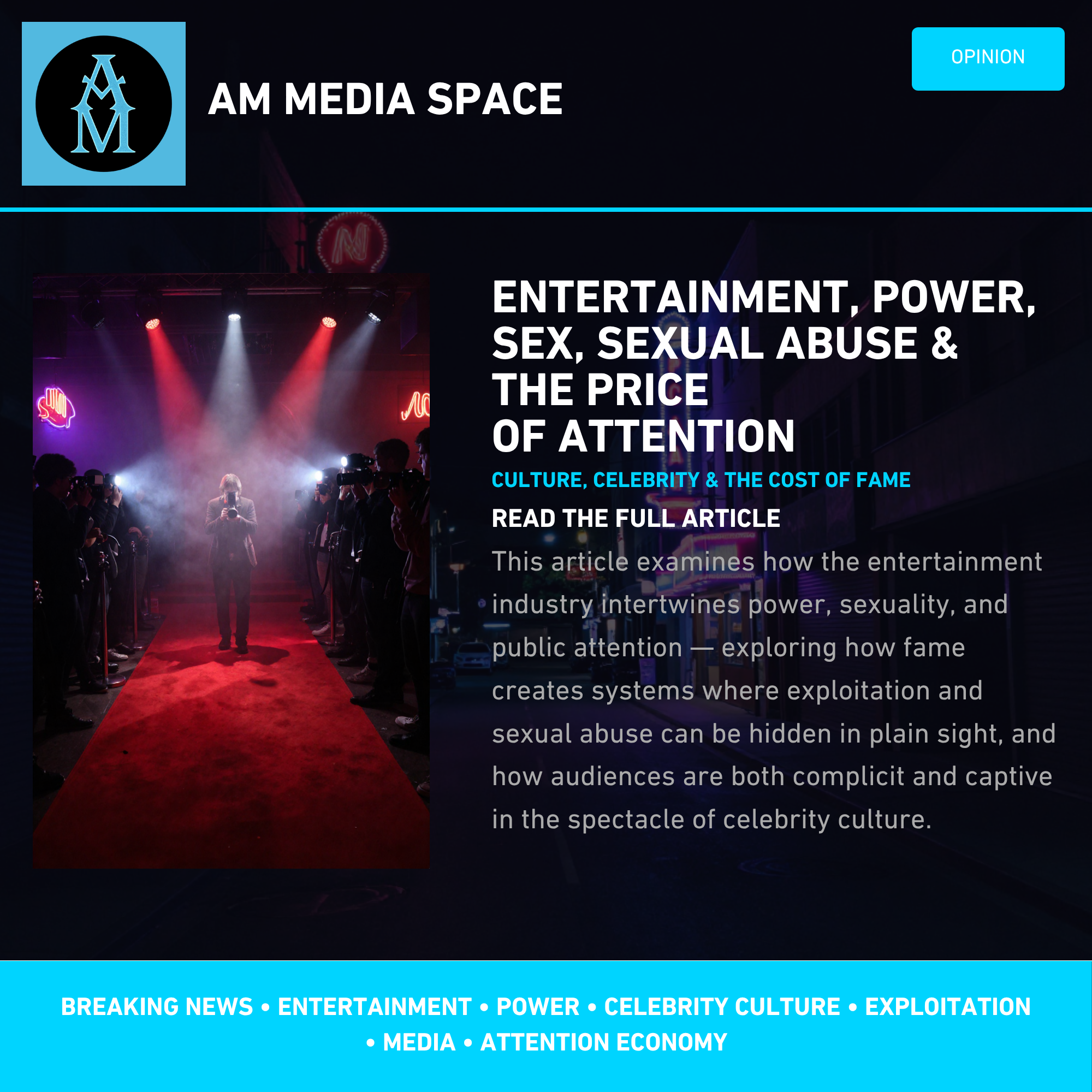
Entertainment, Power, Sex, Sexual Abuse and the Price of Attention
Over the years, I have often found myself asking the same question: why does so much of the entertainment industry seem to revolve around sex, sexual misconduct scandals, abuse allegations, and movements such as #MeToo?
Whether it is Hollywood, the music industry, television, social media influencers, or celebrity culture in general, these topics seem to dominate headlines with surprising regularity.
The question is not necessarily why these stories exist, but why they appear so frequently and why they attract so much public attention.
To understand this, it is important to separate documented facts from personal interpretation.
What the Statistics Show
Over the past several decades, studies across various entertainment sectors have found that sexual harassment and misconduct have been reported by employees, performers, and production staff at varying rates.
Following the rise of the #MeToo movement in 2017, thousands of individuals across film, television, music, journalism, politics, and other industries came forward with allegations and personal experiences involving sexual harassment, abuse of power, and workplace misconduct.
Research conducted in multiple countries has shown that women have generally reported experiencing workplace sexual harassment at higher rates than men, although both men and women have reported such experiences.
The entertainment industry is not unique in facing these issues. Similar concerns have been documented within business, education, healthcare, politics, sport, the military, and many other sectors.
However, because celebrities, actors, musicians, and media executives are public figures, allegations involving them often receive significantly greater media coverage than similar incidents elsewhere.
Why Does Entertainment Appear So Focused on Sex and Sexual Abuse?
My own interpretation is that several different factors combine to create this perception.
Firstly, sex attracts attention. This is not a modern phenomenon; it has existed throughout human history. Entertainment companies understand that sexuality, relationships, attraction, and controversy generate interest.
Films, television programmes, advertising campaigns, music videos, and social media content frequently use sexuality because it attracts audiences and drives engagement.
From a commercial perspective, attention often translates directly into revenue.
The Power Factor
When I look beyond the headlines, I do not think the core issue is necessarily sex itself.
I think the deeper issue is power.
The entertainment industry often creates environments where a relatively small number of people hold significant influence over careers. Producers, executives, agents, directors, record labels, and other gatekeepers can have enormous control over opportunities and advancement.
Whenever large imbalances of power exist, there is a greater potential for abuse and sexual abuse.
This is true not only in entertainment but across many areas of society.
In many high-profile cases that emerged during the #MeToo era, the allegations were not simply about sexual behaviour. They were often about the misuse of authority, intimidation, coercion, or individuals feeling unable to challenge powerful figures without risking their careers.
The Business of Attention
Another factor is the modern media environment itself.
News organisations, websites, social media platforms, and entertainment outlets compete constantly for attention. Stories involving celebrities, scandals, relationships, sexual abuse and controversy often generate more engagement than stories about routine professional work.
As a result, public perception can become distorted.
Most actors spend their days acting. Most musicians spend their days making music. Most production staff spend their days doing ordinary jobs behind the scenes.
However, those stories rarely become headlines.
Instead, the public is repeatedly exposed to extraordinary events, creating the impression that controversy defines the entire industry.
Has Society Become More Sexualised And Addicted To Sexual Abuse?
This is where opinions begin to differ.
Some people argue that modern society has become increasingly sexualised through advertising, celebrity culture, social media, and online content.
Others argue that society has simply become more open about subjects that were previously hidden, ignored, or considered taboo.
The reality may be a mixture of both and an over-do-it on some.
There is little doubt that social media has increased the visibility of public figures and encouraged a culture where image, appearance, and personal branding play a major role in success.
At the same time, there is also greater public discussion about consent, workplace behaviour, accountability, and personal conduct than there was several decades ago.
Why #MeToo Became So Significant
The #MeToo movement became a major cultural moment because it highlighted experiences that many people felt had been ignored for too long.
For some, it represented long-overdue accountability.
For others, it raised concerns about fairness, due process, and how allegations should be investigated.
Regardless of where people stood on individual cases, the movement sparked a broader conversation about power, workplace culture, and professional accountability.
Its influence extended far beyond entertainment and affected discussions within politics, business, education, sport, and many other sectors.
The Role of Celebrity Culture
Another question worth asking is whether society itself contributes to the problem.
Celebrity culture often places individuals on pedestals, giving them levels of attention, influence, and admiration that few people experience.
When society treats public figures as larger than life, there is always a risk that accountability becomes weaker.
At the same time, the public often develops a fascination with both the rise and fall of famous individuals.
Success stories attract attention, but scandals often attract even more.
Can Society Reduce These Problems?
If the root issue is power rather than simply sexuality, then solutions must focus on accountability and transparency.
This may include stronger workplace protections, clearer reporting procedures, independent investigations, and cultures where employees feel able to raise concerns without fear of retaliation.
Education also plays an important role.
Teaching respect, professional conduct, consent, and personal responsibility from an early age can help create healthier workplace cultures in the future.
Equally important is ensuring that accusations are investigated fairly and thoroughly, protecting both those who come forward and those accused until facts are established.
A Personal Reflection
When I look at the entertainment industry today, I do see an industry that is completely obsessed with sexual misconduct.
I see an industry obsessed with attention and sex, exploitation and sexual abuse.
Sex, controversy, fame, relationships, and scandal all generate attention, and attention has become one of the most valuable commodities in the modern world.
The real challenge is ensuring that the pursuit of attention does not come at the expense of integrity, professionalism, or basic human dignity.
The deeper question may not be why entertainment talks so much about sex, abuse, or scandal.
The deeper question may be why society rewards attention so heavily in the first place.
Conclusion
The entertainment industry reflects many of the same strengths and weaknesses that exist throughout wider society.
Issues involving sexual misconduct, abuse of power, and workplace culture are not unique to entertainment, but they become highly visible because of the public nature of the people involved.
While sex often attracts attention, the underlying issue is frequently power, influence, and accountability.
Understanding that distinction may be the key to having more productive conversations about the challenges facing not only entertainment, but society as a whole.
"The biggest currency in modern entertainment may not be money or talent. It may be attention itself."
Comments