
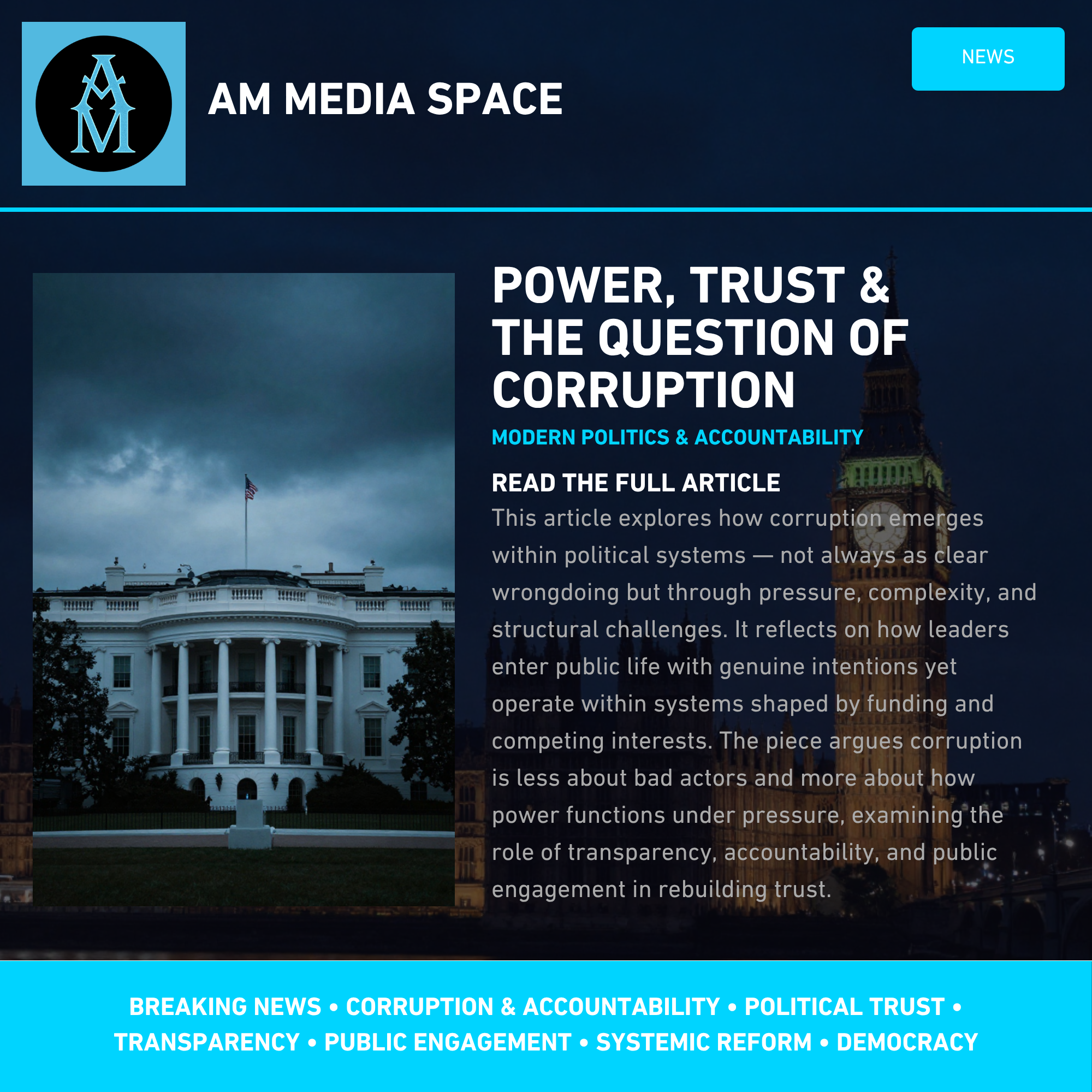
Power, Trust, and the Question of Corruption in Modern Politics
Across the world, people often ask the same difficult question: how many political leaders are truly acting in the public interest, and how many are influenced by systems, pressure, or personal gain?
This question is not new. It has existed for as long as governments themselves. From local councils to national parliaments, from mayors to prime ministers, politics has always involved a complex balance between power, responsibility, and accountability.
It is important to say that most politicians do not enter public life with the intention of corruption. Many begin with genuine beliefs about improving society, helping communities, and creating change. However, once inside the system, they often encounter pressures that are far less visible from the outside.
The Reality of Political Systems
Political systems are built on layers of funding, influence, negotiation, and compromise. Decisions are rarely simple, and leaders are constantly required to balance competing interests from businesses, voters, parties, institutions, and international partners.
In this environment, corruption does not always appear in obvious forms. It can exist as favouritism, influence from donors, pressure from lobbying groups, or decisions shaped by political survival rather than long-term public benefit.
Because of this complexity, it is difficult to put a precise number on how many leaders are “corrupt”. In most cases, the issue is not a clear divide between corrupt and honest individuals, but rather a spectrum of influence, pressure, and compromise that exists within political life.
Why Corruption Develops
There are several key reasons why corruption or unethical behaviour can emerge in political systems.
One of the most significant is power concentration. When decision-making is centralised, the potential for misuse increases if oversight is weak.
Another factor is financial influence. Political campaigns, party funding, and external donations can create situations where access and influence become unevenly distributed.
Short electoral cycles also play a role. Politicians are often judged on short-term results, which can discourage long-term thinking and encourage decisions that prioritise immediate approval over lasting impact.
Finally, complexity itself contributes. Modern governments manage enormous systems, and in such environments, transparency can become difficult without strong accountability structures.
The Role of Trust in Society
At the heart of this issue is trust. Democratic systems rely on the belief that leaders are acting in the public interest. When that trust is weakened, people become more disengaged, more sceptical, and more likely to feel disconnected from political life.
This creates a cycle where lower trust leads to lower participation, which can further reduce accountability and transparency over time.
Breaking this cycle requires more than criticism. It requires structural improvement, civic engagement, and stronger public understanding of how systems actually operate.
Can Corruption Be Reduced?
While it may not be possible to eliminate corruption entirely from politics, it can certainly be reduced and controlled through strong systems and cultural expectations.
Transparency is one of the most effective tools. When decisions, funding, and processes are visible and accessible, it becomes harder for unethical behaviour to remain hidden.
Independent oversight is also essential. Institutions that are separate from political influence can help ensure that rules are followed and that misconduct is properly investigated.
Another important factor is media and public scrutiny. A well-informed society that asks questions and holds leaders accountable plays a crucial role in maintaining standards.
Education also matters. When people understand how government works, they are better equipped to recognise when systems are functioning properly and when they are not.
Rethinking Leadership
It is easy to view politics as a struggle between good and bad individuals, but the reality is more complicated. Most leaders operate within systems that shape their decisions as much as their personal values do.
This does not remove responsibility, but it does highlight the importance of designing systems that encourage integrity rather than pressure people away from it.
Strong leadership is not only about individual character. It is also about creating structures where honesty, accountability, and long-term thinking are rewarded rather than punished.
A Final Reflection
Perhaps the real question is not how many politicians are corrupt, but how many systems allow pressure, influence, or short-term thinking to override public interest.
Understanding this difference is important, because it shifts the focus from blame alone to improvement and reform.
If societies want better leadership, they must also build better systems around leadership — systems that reduce unnecessary influence, increase transparency, and strengthen trust between the public and those in power.
"No system survives on trust alone — it survives on accountability, transparency, and the willingness to improve."
Comments