
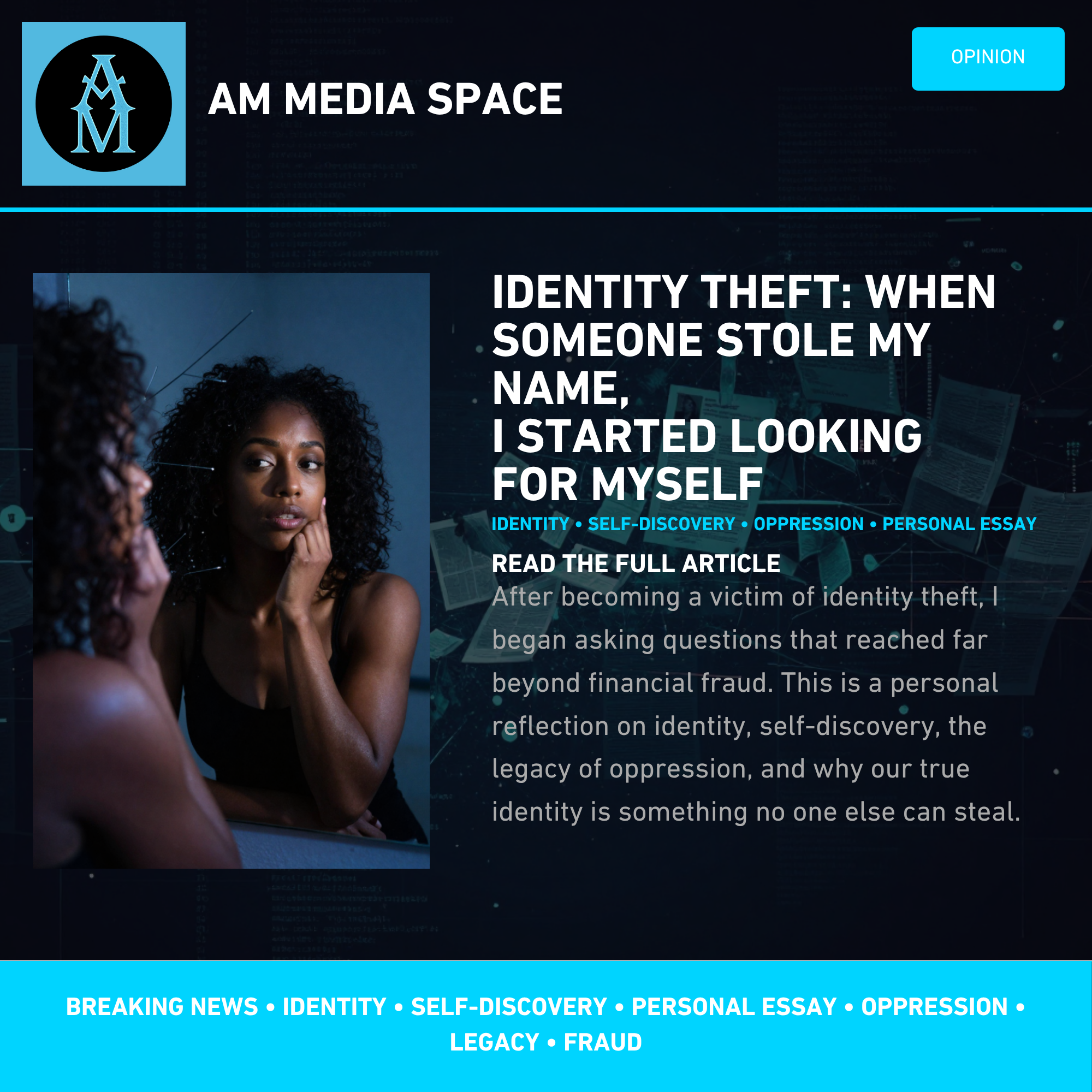
Identity Theft: A Conversation About Me and Why People Are Stealing My Identity
Sometimes the biggest questions don't begin with answers. They begin with conversations.
Where It Started
I asked a simple question that eventually became something much bigger.
"Why do people commit identity theft? If they are not comfortable being themselves then what's the point of trying to be someone else? You won't be happy long term."
At first glance, it seems like a question about crime. But beneath that question is another one:
What is an identity, and why is it valuable?
Most people assume identity theft is about becoming someone else. Perhaps it isn't.
Perhaps it's about using another person's identity as a tool to gain access to money, opportunity, or influence. The identity itself becomes a key rather than a destination.
Then the Conversation Became Personal
I shared something that changed the direction of the discussion.
"I have had my identity stolen."
That statement isn't only about fraud.
It's about what happens when someone takes something that represents you while knowing nothing about who you actually are.
The more I thought about it, the more I realised my question wasn't only about criminals.
"I was never told who I am, but people who seem to know me more than I know myself are using my identity for personal gains."
That sentence stayed with me.
It describes something many people experience in different ways.
Sometimes it's identity theft.
Sometimes it's family expectations.
Sometimes it's employers, institutions, companies or people who decide who you are before you've had the opportunity to discover it yourself.
Who Owns an Identity?
Legally, an identity belongs to records, documents and databases.
Personally, an identity belongs to your memories, experiences, values and choices.
Those two things are often confused.
A criminal can steal your bank account.
They cannot steal your character.
Someone can impersonate your name.
They cannot become the person behind that name.
The more I reflected on this, the more I realised something important.
The people who profit from your identity don't actually know you. They know a version of you that is useful to them.
That version might be a passport.
A driving licence.
A credit file.
A social media account.
Or simply other people's assumptions.
None of these things are the whole person.
The Question We Rarely Ask
The conversation eventually moved beyond identity theft.
It became a discussion about identity itself.
"If no one else's opinions counted—not your family's, not institutions', not someone who misused your identity—how would you describe who you are?"
That's a difficult question.
Many of us spend years living according to other people's expectations before asking ourselves what we actually believe.
Maybe that is why identity theft feels so personal.
It isn't only the theft of information.
It can also force us to ask who we really are when everything that supposedly identifies us can be copied, forged or exploited.
Identity Before Identity Theft
As a Black woman, I couldn't help asking myself another question.
For generations, Black people have lived with the consequences of slavery, colonialism and discrimination. Families were separated. Names were changed. Languages were lost. Histories were rewritten. In many cases, people were denied the right to define themselves on their own terms.
"Did we struggle with our identity before enslavement, or did enslavement make us question who we are?"
I don't claim to have the answer. But I believe it's a question worth asking.
When generations of people are told who they are, what they are worth, and where they belong, reclaiming identity becomes more than a personal journey. It becomes an act of healing and self-definition.
That is one reason why having my identity stolen felt like more than financial fraud.
It felt as though something I was still discovering about myself had been taken and used for someone else's benefit.
What made the experience even more difficult was learning that the people responsible were Black.
I don't believe their actions represent Black people as a whole. Every community includes people who make harmful choices. But it left me with another difficult question.
"Why would someone who understands, or could understand, what it feels like to have identity shaped by oppression choose to exploit another person's identity?"
I don't know the answer.
Perhaps it's about greed. Perhaps it's about opportunity. Perhaps it's about believing another person's identity is simply something to be used.
Whatever the reason, the experience taught me that shared history doesn't always create shared responsibility. Compassion and integrity are choices, and they belong to each of us.
My Reflection
Looking back, I no longer think my original question was really about why people steal identities.
It was about why identity matters in the first place.
I still believe what I said at the beginning.
"If you're not comfortable being yourself, what's the point of trying to be someone else? You won't be happy long term."
Perhaps people who steal identities aren't looking for another self.
Perhaps they're looking for another life.
But borrowing someone else's identity can never solve the deeper problem of not knowing yourself.
For me, this journey has taught me something unexpected.
Identity isn't something that other people give us.
It isn't something a criminal can truly take away.
It's something we gradually discover through our experiences, our values and the choices we make every day.
And maybe that's the one thing no one else can ever steal.
Final Thought
"The greatest identity you'll ever own isn't the one printed on your passport. It's the one you build through the life you choose to live."
Comments