
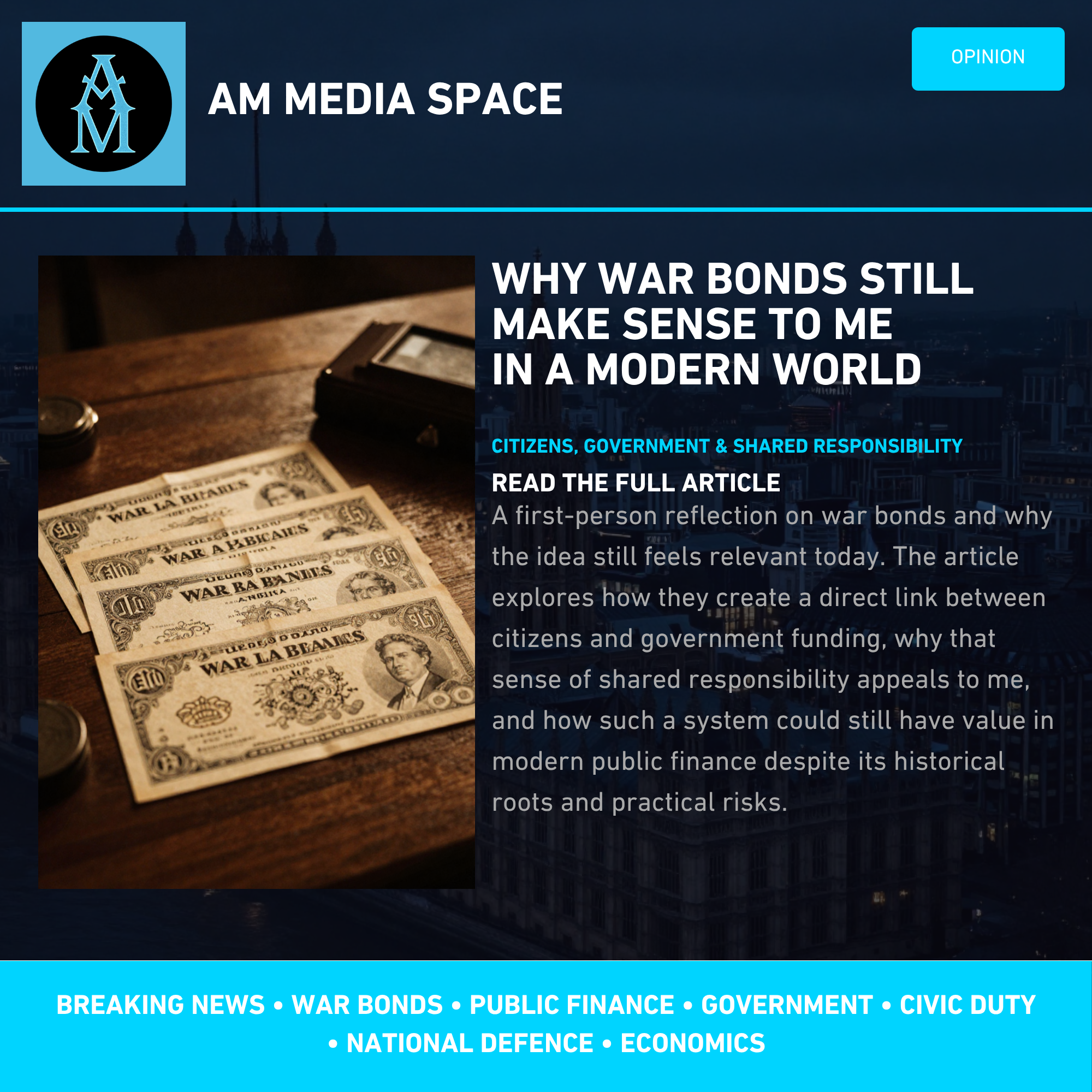
Why War Bonds Still Feel Like a Good Idea to Me
I’ve recently found myself thinking about war bonds more than I expected to. Not in a nostalgic way exactly, but in a practical one. The idea of ordinary people directly contributing to national stability, especially in times of crisis, feels like something that still has value today.
I know war bonds are mostly associated with the past, particularly during the world wars, but the concept behind them still stands out to me. It’s simple: the government borrows money from its own people, and in return, pays it back later with interest.
On the surface, it sounds almost old-fashioned. But when I look at how governments fund emergencies, defence, and infrastructure today, I don’t think the idea is outdated at all. If anything, it feels like something that could be adapted for the modern world in a more transparent and structured way.
What War Bonds Actually Represent to Me
When I think about war bonds, I don’t just think about finance. I think about participation.
During the Second World War, citizens weren’t just watching events unfold—they were financially involved in supporting their country. That sense of shared responsibility is something I feel has faded over time.
Today, most people experience national decisions indirectly. Taxes are collected automatically, government borrowing happens through markets and institutions, and the average person has very little visible connection to how major spending is funded.
War bonds, in contrast, create a direct link between the public and the state. That connection is what interests me most.
How I Understand the Idea
From what I understand, a war bond is essentially a loan to the government. You give money, and after a set period, you receive it back with interest.
It’s not charity, and it’s not a donation. It’s investment with a defined return.
In modern terms, we already have similar systems through government bonds and savings schemes. But the difference is that “war bonds” carry a stronger sense of purpose. They are tied to national effort, urgency, and collective responsibility.
Why I Think It Could Still Work Today
One of the reasons I find the idea interesting is because it could potentially help bridge a gap between governments and citizens.
In a time where trust in institutions often feels fragile, something like this could create a clearer relationship: the public supports national priorities directly, and the government has a more transparent way of raising funds beyond taxation.
I also think it could give people a sense of involvement in major national projects, whether that’s defence, infrastructure, energy security, or emergency response.
There is something powerful about the idea that citizens are not just passive observers of national decisions, but active contributors to them.
Of Course, I Understand the Risks
I’m not looking at this through completely rose-tinted glasses.
Any system like this depends heavily on trust. People would need confidence that their money is safe and that repayment is guaranteed. It would also need strong economic management to avoid burdening future generations with debt.
There is also the question of whether governments would use such a system responsibly or whether it could become another political tool.
These are real concerns, and I don’t think they can be ignored.
Why the Idea Still Sticks With Me
Despite the challenges, I keep coming back to the same thought: the principle itself is solid.
It turns national finance into something more visible and participatory. It gives people a way to contribute beyond voting or paying taxes. And it creates a sense of shared responsibility during moments that affect everyone.
Even if war bonds in their traditional form belong to history, I can’t help thinking the underlying idea still has relevance today in a world that often feels financially and politically distant from ordinary people.
A Final Thought
I suppose what interests me most is not just the financial return, but the connection it represents between people and the state.
It’s a reminder that large systems are still built from collective input, even if that input is usually invisible.
And while I don’t know whether modern governments would ever seriously bring back something like war bonds in their original form, I do think the idea raises an important question: how involved should citizens be in funding and shaping the future of their country?
For me, at least, it’s an idea worth thinking about.
Comments