
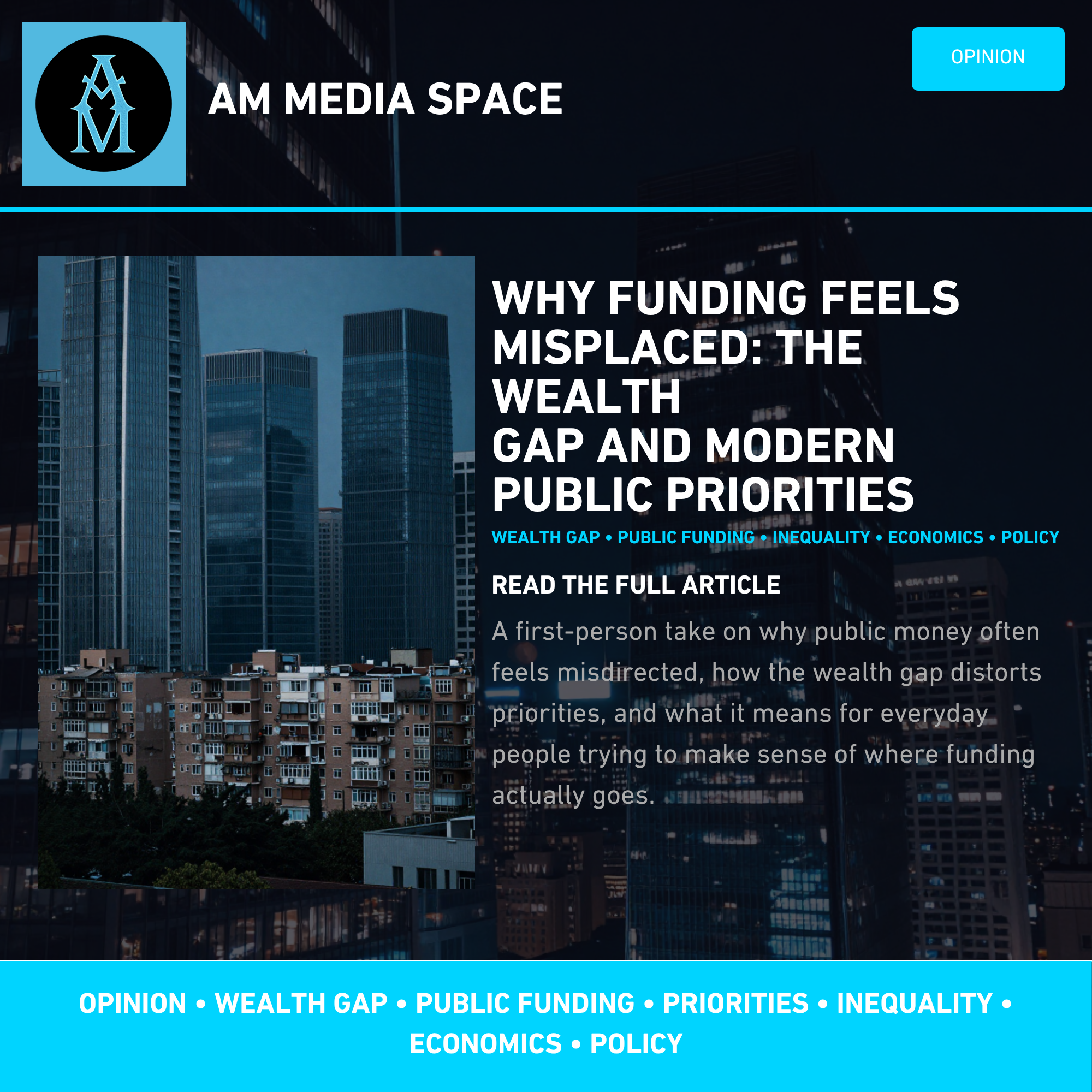
It Feels Like Funding Isn’t Going Where It Should — and the Wealth Gap Keeps Coming Back Into It
After looking through issues like healthcare, education, justice, disability support, and wealth inequality, I keep coming back to the same first impression: funding doesn’t always feel like it is reaching the places where it is most needed.
At first, my reaction is quite straightforward. It seems like certain parts of society are under pressure — schools, the NHS, disability support systems, housing, and local services — while at the same time there is a growing concentration of wealth at the very top of society. That contrast raises a simple question in my mind: if resources exist in the wider economy, why does it feel like they are not evenly supporting the areas that hold society together?
The Wealth Gap and Where Influence Comes In
When I look at the wealth gap, I don’t see it as a simple “rich vs poor” idea. It feels more like a structural imbalance where a small number of individuals, companies, and institutions hold a very large share of financial power compared to everyone else.
Even if this does not directly control government budgets, it does seem to influence how priorities are shaped. Wealth can affect politics through donations, lobbying, investment decisions, and the wider direction of economic policy. Over time, that can shape which sectors grow and which ones struggle to keep up.
So while governments still officially control public spending, the environment in which those decisions are made is not neutral. It is influenced by economic pressure, political debate, and financial interests that are not evenly distributed.
Why Funding Can Feel “Misplaced”
There is also another layer to this. Even without direct influence from wealth, funding decisions are complicated. Governments have to balance limited budgets against rising demand in multiple areas at the same time.
For example, healthcare demand is increasing, education systems are under pressure, and disability support services like EHCPs are often stretched. At the same time, other areas of spending compete for the same resources, and political priorities change over time.
This creates a situation where, from the outside, it can feel like money is not reaching the most urgent needs, even if the underlying decisions are more complex than they first appear.
The Education and Disability Example
This becomes especially visible when looking at education and disability support. Systems like Education, Health and Care Plans (EHCPs) are legally designed to support children with additional needs, including autism, but in practice they often depend on local funding, staffing, and capacity.
So even when legal rights exist, the ability to deliver them consistently can vary depending on where someone lives and how well-resourced their local authority or school system is.
That gap between legal expectation and real-world delivery is where many of these concerns become most visible.
So Is It Just About the Wealth Gap?
From my perspective, the wealth gap is not the only reason funding feels uneven, but it does sit underneath a lot of the wider structure. It affects investment patterns, political influence, and economic direction, which then interacts with government decision-making.
But it is also important to recognise that public funding is shaped by multiple factors: political choices, economic conditions, population needs, and institutional capacity. It is not controlled by a single group or a single cause.
A Final Reflection
What stands out to me most is not just inequality itself, but how connected everything is. Healthcare, education, justice, disability support, and wealth distribution are not separate issues — they all interact with each other.
So when it feels like funding is not going where it should, it may not be down to one single reason. It is more likely a combination of structural inequality, economic pressure, and competing priorities within the system.
Still, the question remains important: if society produces enough wealth overall, how do we ensure it is directed in a way that supports the systems everyone relies on?
Comments